
ISO 14024 defines the principles and procedures for the development and awarding of Type I eco-labels. These labels are certified by a neutral body and show how environmentally friendly a product is compared to other products in its category. Various environmental aspects are taken into account over the entire service life of the product. The standard determines how the products are divided into groups, which environmental criteria and quality requirements apply to each group and how compliance with these criteria and requirements is checked and verified.
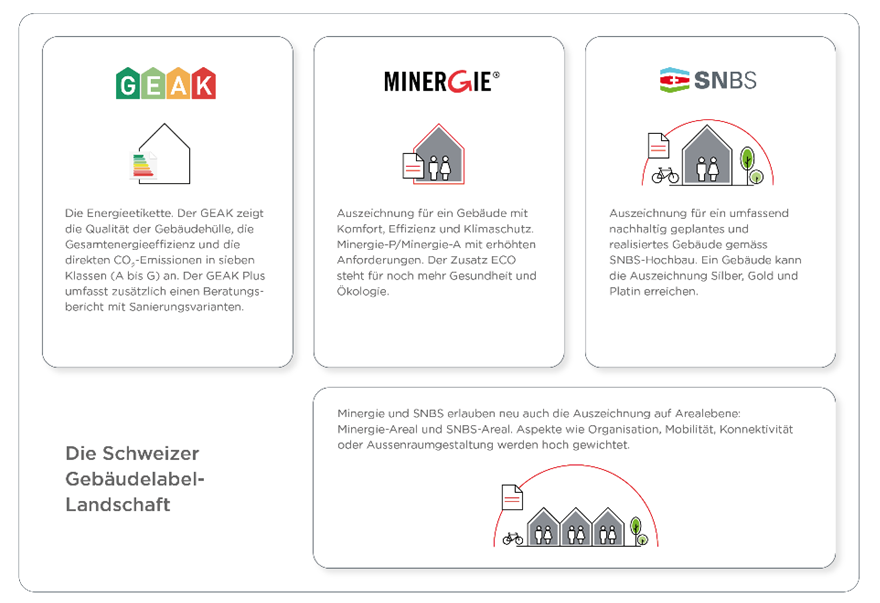
Since September 2023, Switzerland’s building labels – Minergie, GEAK52, SNBS building construction53 and 2000-watt sites – have been redesigned54. There are now only two labels available for buildings and sites plus the cantonal building certificate (GEAK). The previous 2000-watt site is now replaced by the Minergie site55 and the SNBS site. The basis for calculating energy consumption and environmental emissions has been standardized. This relates specifically to energy consumption andCO2 emissions during the operation of the building. All calculation methods are now based on the standardization of the GEAK. Since the beginning of 2023, the GEAK has had a third scale for directCO2 emissions.
In addition, the Minergie standards have been significantly tightened, particularly in the areas of in-house electricity production, greenhouse gas emissions during construction, heating requirements and thermal insulation in summer. Minergie means that the buildings consume less energy overall and are more future-proof in terms of heat insulation.
The SNBS building construction now only includes 35 instead of 45 criteria. However, all areas of sustainability (social, economic and environmental) are still taken into account.
All certification applications can be recorded and submitted on the same label platform. This means that the different labels can be compared at the application stage, and multiple certifications are also possible. This reduces the effort involved in certification for applicants and certification bodies.
One of the aims of the building labels is to keep overall primary energy consumption low. In addition, the proportion of non-renewable primary energy is to be reduced in favor of renewable primary energy. The reduction of greenhouse gases usually goes hand in hand with a reduction in energy consumption, but can create diametrically opposed incentives in individual cases. For this reason, primary energy remains an important indicator in the life cycle assessment, particularly in view of the current energy shortage. In order to avoid creating unintended negative incentives by reducing greenhouse gases, it is therefore important to keep an eye on all environmental impacts. Today, life cycle assessment data provides further interesting results, such as information on how much energy can be recovered from the building materials at the end of the life cycle or how much carbon is stored over the life cycle of the building.
52 GEAK
53 SNBS Building construction
54 admin.ch: From label salad to label family: What’s new with labels in the building sector
55 Minergie
Copyright
This document is licensed under a Creative Commons Attribution-NonCommercial-ShareAlike 4.0 International License as Attribution-NonCommercial-ShareAlike
For more information see: Creative Commons
