
The Environmental Product Declaration (EPD) describes construction products in terms of their environmental impact based on life cycle assessments as well as their functional and technical properties. EPDs are proven procedures for declaring the environmental performance of a building product in the life cycle phases of manufacture and disposal. They are suitable for calculating functional units or entire systems, on the basis of which the results are then interpreted.
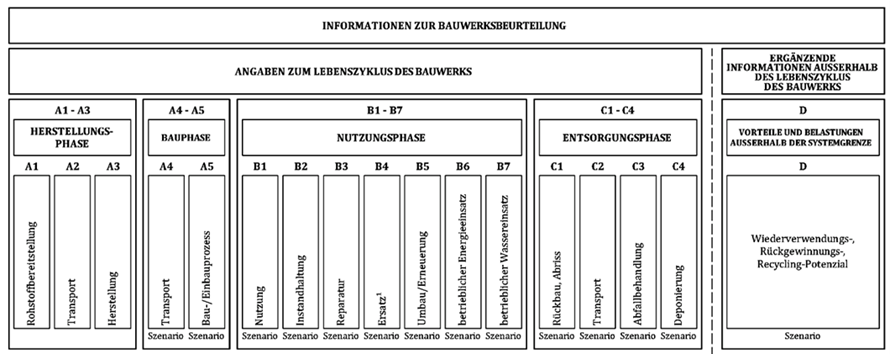
Environmental declarations of building materials with quantitative statements, such as the Environmental Product Declaration (EPD), are classified as type III ecolabels in accordance with ISO 14025. The basic rules for the product category of construction products are described at international level in ISO 2193046. In Europe, these rules have been adopted and slightly supplemented in SN EN 15804+A247. In EPDs, the indicators for environmental impacts are presented as values according to life cycle phases with their modules in tables. For building products, only modules A1-A3 and C1-C4, as well as module D, are usually specified in EPDs.
8.3.1 Provision and use of life cycle assessment data
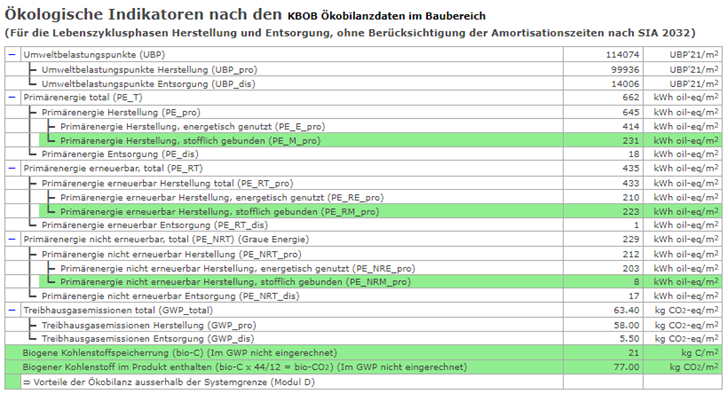
The life cycle assessment data in the construction sector of the Coordination Conference of Building and Real Estate Bodies of Public Building Owners (KBOB), the Interest Group of Private Professional Builders (IPB) and ecobau are based on a federal LCI database in collaboration with ecoinvent48. The KBOB life cycle assessment data is largely generic, i.e. it is calculated on the basis of average data from manufacturers and thus represents an entire group of specific products. The advantage of this is that companies could rely on this data if it were required in the future under the Construction Products Act. In addition to this generic data, there are also more specific data sets, for example from manufacturers who wish to differentiate themselves from the average data and have an EPD drawn up themselves or who will have to provide these in future due to their relevance under the law.
8.3.2 EPD database
Due to the lack of exchange formats and machine readability, companies have started to collect EPDs and make them available for digital processing with their tools, products (software), databases and services. The definitions in EN 1580449 leave room for maneuver, which can lead to different assessments of construction products. The corresponding national framework conditions for ensuring comparability are set out in the national foreword to SN EN 15804.
The LCA software tools also include the respective requirements and weighting grids to create building LCAs quickly and easily in compliance with Type I ecolabels such as DGNB, LEED, GRESB, BREEAM and Level(s). In some cases, they also include the option of mapping life cycle inventories (LCI) of products and thus creating EPDs.
46 ISO 21930:2017 – Sustainability in buildings and civil engineering works – Core rules for environmental product declarations of construction products and services
47 SN EN 15804+A2:2022-11 – Sustainability of construction works – Environmental product declarations – Basic rules for the product category construction products
48 Ecoinvent
49 EN 15804:2022 – Sustainability of construction works – Environmental product declarations – Basic rules for the product category construction products
Copyright
This document is licensed under a Creative Commons Attribution-NonCommercial-ShareAlike 4.0 International License as Attribution-NonCommercial-ShareAlike
For more information see: Creative Commons
