
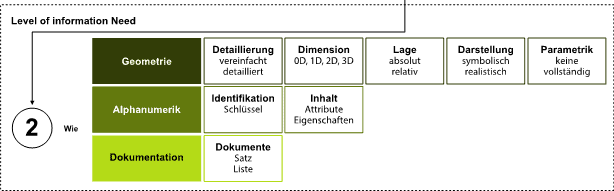
In the second step, the “how” or the definition of the level of information need, the type of information must be designated. In SN EN 17412-1:2020, three categories are used to designate the type (characteristic) of information delivery. The aim is to provide information that can be interpreted by machines and humans.
- Geometry Information defined as detail, dimension, position (location), visual appearance and parametrics.
- Alphanumeric Information that is identified via unique keys (source) and designated via attributes and properties.
- Documentation Information that represents the delivery result at a specific point in time.
1. geometric information
To define the geometric information for one or more objects, the following independent aspects should be defined.

Detailing
Describes how an object is structured in its detailed geometric resolution in relation to the intended reality. The detailing can be very rudimentary and act as a placeholder in the overall model for connecting further information. However, objects can also be comprehensively detailed in order to achieve optimum proximity to the planned reality.
Examples:
- Door that is reduced to a hole in a wall versus a door that is divided into all its components, i.e. the frame, the door leaf, the door handle, the threshold, etc.
- Ceiling that is reduced as an orthogonal, spatial body versus ceiling that is structured as a wooden beam ceiling in all its components, with the beam layer, the false floor, the impact sound insulation, the floor covering, etc.
Note: See also Chapter 14 Dealing with the LOG / LOI definition and examples of the depth of information required.

Dimension
Represents the number of spatial dimensions that characterize the object. The object can be provided in its dimensionality from zero-dimensional 0D to three-dimensional 3D.
Examples:
- Zero-dimensional, 0D as location point
- One-dimensional, 1D as a line
- Two-dimensional, 2D as surface, area
- Three-dimensional, 3D as a body, volume

Location
The location of an object is a central prerequisite for interdisciplinary collaboration. The position and orientation of an object can be absolute in relation to a reference point or relative to another object.
Examples:
- Absolute position of an object in a grid, with its position and orientation relative to a reference point, such as the survey point in a coordinate reference system (LM95).
- Structural reference within the model, such as site, building, storey and component (site, buiding, story, object).
- Position of an object in relation to another object, such as a row of columns set in a certain grid, a door in a certain position in a wall.

Representation
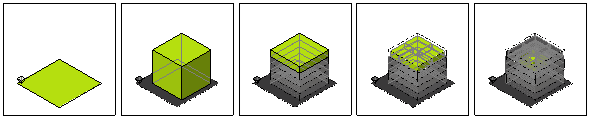
The visual representation of an object can range from a reduced, symbolic representation to a realistic representation with reference to the real world. Surface properties such as coloring, transparency, reflectivity or emissivity can be represented in a diffuse to very precise manner.
Examples:
- The type of components can be highlighted by means of color coding, such as hot and cold water pipes, high and low voltage cables, etc.
- An object can be represented in a simplified form as a symbol, such as a lamp, a light switch, etc.
- Colors can be assigned to the individual area types for the designation of areas and types of use in SIAd0165.
- Colors can be assigned to identify the zones and components in fire protection.
Parametrics
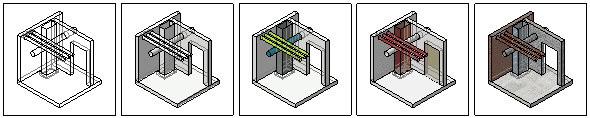
Parametrics refers to whether the position, dimensions, detailing, display and orientation of an object can be created and changed or reconfigured based on parameters. The parametric behavior of an object can be transferred as part of the information provision and can therefore be completely or partially changed.
Examples:
- An object can be changed in its parametric behavior by changing the parameters, e.g. in the dimension, detailing, etc.
- Components such as doors and windows can be adapted to the situation and dimensions required in the project.

2. alphanumeric information
To determine the alphanumeric information for one or more objects, the identification and information content must be defined.

Identification
Identification is used to position an object within an outline structure. Positioning is important for the structure and efficient management as well as information management. It is the prerequisite for ensuring the translation (mapping) of different structures.
Examples:
- Designations, type designation, classification Name, type designation, classification, coding, reference structure, index, numbering, etc., e.g. area and usage types according to SIAd0165, costs according to eBKP-H, component types.
- Structuring within the authoring software (native – Allplan, Revit, Archicad, Vektorworks, etc.) and structuring of the IFC data model.
- The GUID, Globally Unique Identifiers, for the unique identification of an object, the attributes.
The name as well as the type designation and classifications can be represented by or linked to a data template in accordance with SN EN ISO 23387 and form a generally valid basis for describing the characteristics of structural objects (e.g. products, systems, assemblies).
Contents
Depending on the intended use, specific information is required for the delivery objects and outline structure. The use case is the starting point for determining the information and the depth of information required. Ideally, the structure of the outline and the characteristics takes into account the structure of the medium via which the delivery objects are provided. The open standard for this is IFC5. The identification of the individual objects via the characteristics helps those involved to make this information accessible to a wide range of users. The alphanumeric information can be grouped based on types and groups with similar properties (doors and windows, wall and ceiling coverings).
Examples:
- Information on the load-bearing behavior of components, e.g. load-bearing – non-load-bearing.
- Information on the edge protection class or heat transfer coefficients of a component, etc.
- Information on components in operation, such as cleaning, maintenance cycles, etc.
- Information on the technical properties of a component, such as the product actually required or used.
The characteristics, alphanumeric information, in data templates can be created in accordance with SN EN ISO 23386.
3. documentation
The project requires further information, which must be provided in the form of documents. The documents required in the project must be named by the parties involved.

The documentation for one or more objects supports processes, decisions, approval and verification of information provision and should be available in corresponding documents. Interim or final results can be easily documented in this way.
It is advisable to define the nature, type and number of documents and to determine the date on which they must be available. These documents, also known as delivery objects, can be identified in planning lists and document versions.
Examples:
- Reports on the structural condition, the building site, etc.
- Documentation via photo of the condition and/or status of work on site.
- Sketches, plans and diagrams, etc.
- Acceptance reports, warranty certificate, etc.
- Provisions, agreements and contracts, copies signed by the parties involved.
5IFCIndustry Foundation Classes: Open international standard for the exchange of digital building models according to SN EN ISO 16739
Copyright
This document is licensed under a “Creative Commons Attribution-NonCommercial-ShareAlike 4.0 International License” as Attribution-NonCommercial-ShareAlike under the same conditions
